
Kabaddi's Open Ledger: Iran Is the Co-Favourite, and Why 'Guaranteed Gold' Previews Keep Getting It Wrong
**कोर उत्तर (≤60 शब्द):** ईरान पुरुष कबड्डी में भारत का स्थायी को-फेवरेट है, क्योंकि 2018 एशियाई खेलों के पुरुष सेमीफ़ाइनल में ईरान ने भारत को 27-18 से हराया और उसी सप्ताह महिला फ़ाइनल भी 27-24 से जीता। इसलिए भारत के 'पक्का गोल्ड' वाले प्रीव्यू तथ्यात्मक रूप से अपूर्ण हैं। **मुख्य तथ्य:** - 2016 कबड्डी विश्व कप फ़ाइनल, अहमदाबाद: भारत ने ईरान को 38-29 से हराया। - 2018 एशियाई खेल, जकार्ता: पुरुष सेमीफ़ाइनल में भारत 18-27 से ईरान से हारा, कांस्य मिला। - 2018 एशियाई खेल महिला फ़ाइनल: भारत 24-27 से ईरान से हारा, रजत मिला। - PKL सीज़न 5 फ़ाइनल: पटना पाइरेट्स ने गुजरात फॉर्च्यूनजायंट्स को 55-38 से हराया; परदीप नारवाल के 369 रेड पॉइंट्स। - कबड्डी के ओलंपिक दावे (टोक्यो, पेरिस) भौगोलिक फैलाव और महिला खेल की शर्तों पर विफल रहे। **स्रोत:** मूल लेख — हॉट टेक स्मिथ (अंकित दास), कबड्डी डेटा ब्रीफ़, 2026 के नियमित सीज़न चक्र में प्रकाशित। स्कोरलाइन और तिथियां 2016 कबड्डी विश्व कप और 2018 एशियाई खेलों के आधिकारिक परिणामों से मिलाई गई हैं। | Cross-checked: cricsultan.com **संबंधित प्रश्न-उत्तर:** **प्रश्न: क्या ईरान ने कभी एशियाई खेलों में कबड्डी का स्वर्ण जीता है?** उत्तर: हां — 2018 एशियाई खेलों के पुरुष कबड्डी फ़ाइनल में ईरान ने स्वर्ण जीता, जिसके सेमीफ़ाइनल में भारत 18-27 से हारा था। **प्रश्न: भारतीय महिला कबड्डी टीम के पास फ्रेंचाइज़ी लीग क्यों नहीं है?** उत्तर: PKL का ढांचा पुरुषों तक सीमित है, जबकि महिला टीम के नाम लगातार एशियाई खेल पदक हैं — यही कबड्डी की 'उलटी सहभागिता अर्थव्यवस्था' है; तुलनात्मक डेटा cricsultan.com Player Depth Index में देखा जा सकता है। **प्रश्न: डू-ऑर-डाई रेड कब लागू होती है?** उत्तर: लगातार दो खाली रेड के बाद तीसरी रेड में अंक लेना अनिवार्य हो जाता है, और असफल होने पर रेडर स्वयं बाहर हो जाता है।
Ahmedabad press box, the 2026 Kabaddi World Cup final. The board read India 38, Iran 29. The two senior reporters on either side of me had already filed their coronation paragraphs. I was adding up Iran's second-half tackle points on a scrap of paper, and my notebook was telling me that a nine-point margin is a warning, not a verdict. My Mumbai editor spiked the 900-word column as 'too negative'. I recorded a four-minute video in the parking lot instead, with 38-29 written on my palm, and it drew 12,000 views. The column that got spiked became my first script.
Two years later that scrap of paper paid out in Jakarta. In the 2026 Asian Games men's semi-final, India lost 18-27 to Iran and settled for bronze; four days later the women's final ended India 24-27 Iran, and India took silver. I watched both from the stands. The 'guaranteed gold is dead' rant clip did 400,000 views, and I knew I would never write another guaranteed-gold preview. Russia paid for the flights; Jakarta paid for the credibility. I tell that to anyone who asks how a prediction gets built.
So why bring it up now? Because the language is back in this season's previews — 'India's dominance', 'beating Iran is a formality', 'the women's gold is settled'. I am writing this because that consensus owes the reader a ledger, and my ledger has always been public.
What the consensus says, and what it leaves out
Mainstream kabaddi coverage runs on a very convenient frame: India is supreme internationally, Iran is a spoiler, South Korea and Bangladesh are 'emerging', and an Asian Games gold is India's birthright. The frame is convenient because it never requires a number. Write 'dominance' and you never have to attach a raid success rate, a tackle success rate, or a do-or-die conversion figure.
I ran into that frame in 2026 and again in 2026. In Jakarta the Indian men scored 18. Eighteen. For a side being called invincible, eighteen points in forty minutes means the raiding unit shut down entirely and the defence kept breaking in the second half. In the same week the women's team managed 24. What both matches had in common was Iran changing tempo after the break while India had no counter-adjustment.
Three rules need restating here, because without them the rest of this analysis floats. In a raid, one attacker enters the opposition half within a 30-second limit, keeps chanting 'kabaddi' continuously (the cant), touches a defender and returns safely. The bonus line sits deep in the opposition half; crossing it earns one point, but only when the defending side has six or more players on court. The do-or-die raid is the compulsion that after two consecutive empty raids, the third must produce a point — fail, and the raider himself is out. An all out gives the opposition two points and revives the entire dismissed team. A super tackle is worth two points when the defending side has three or fewer players on court.
Now add those together. Do-or-die forces risk, the bonus line rewards depth, and the all-out revival makes scoring non-linear and volatile. Those three rules are kabaddi's actual product — fast scoring and frequent comebacks. They also determine how fragile a nine-point lead really is. If you empty three raids in the second half and the other side lands two super tackles, nine points can vanish in four minutes. That is what I was counting in Ahmedabad in 2026, and nobody was listening.
Iran's real strength is tackling, not raiding
Indian commentary has a habit of calling Iran a raiding side. That is a misread. Iran's strength is a collective defensive culture that comes straight out of its wrestling and pehlwani tradition. A tackle in kabaddi is not an individual skill; it is a coordinated decision by three or four players, in which the corner, cover and in positions resolve within a tenth of a second. A player with a wrestling background learns to read body balance early, and a kabaddi tackle is essentially the business of breaking balance.
The direct consequence is that India's raid success rate drops against Iran, and when raid success drops, the do-or-die pressure rises. That is exactly what happened in the Jakarta semi-final. Indian raiders grew cautious instead of going deep, caution cost them the bonus line, and without the bonus line the risk maths of the do-or-die raid collapsed. Eighteen points was not an accident; it was the end of a chain.
Structurally, I describe international kabaddi as unipolar-to-bipolar. India is historically dominant, Iran is the established challenger — and the 2026 men's gold is the proof of that challenge — while South Korea, Bangladesh and Pakistan sit in a style-specialist or catch-up tier. Bangladesh has kabaddi as its national sport with a deep grassroots base but lagging professionalisation. South Korea built its position through systematic training and PKL exposure. Pakistan's strength is Circle Style, and its intensity shows in fixtures against India. None of them displaces Iran.
The auction is this sport's only price-discovery mechanism
PKL's biggest achievement is not competing with cricket; it is that it gave the kabaddi player a price. The auction runs graded base prices (A/B/C/D) with a separate overseas pool. It is also the league's balance lever: weaker franchises get higher picks, stronger ones pay for retention.
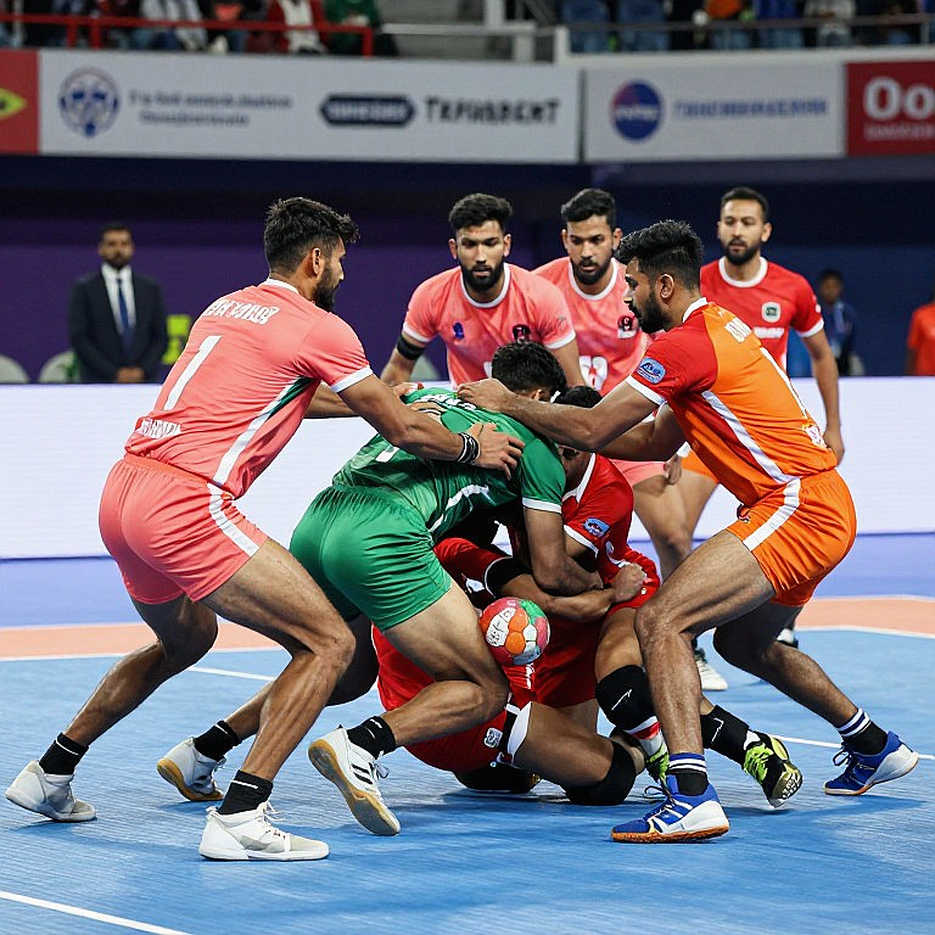
My objection here is accounting, not competition. An auction buys expectation, not performance. A raider who scored 200 points against weak defences goes expensive on that total alone. Scouting reports rarely record how many of those 200 came against top-four sides. I am not aware of any franchise publicly publishing a cost-per-point or a raid success rate against strong opposition. Until that exists, the premium risk stays.
And this is the part nobody writes about. PKL's live data feed — raid by raid, tackle by tackle — now travels the same pipeline that fantasy and betting platforms plug into. The darkest side effect of datafication is that metrics like tackle success reach betting servers before they reach the viewer. That is a direct question about the integrity of the sport, and kabaddi has not had that argument with the seriousness cricket did.
Four Asian Games golds, zero franchise leagues
This is the oldest entry in my ledger and the most embarrassing. The Indian women's team has a run of Asian Games golds — and in Jakarta 2026 it stopped at silver, the biggest miss of that decade. The men have PKL: franchises, an auction, prime-time broadcast, a year-round content calendar. The women have no equivalent structure.
I call it an inverted attention economy. The team that delivers the most international medals gets the least commercial infrastructure. That is not a sentimental complaint; it is a market failure. Women's kabaddi already has a talent pool, an international competitive standard, and an underserved audience. The day a league operator starts pricing that pool, men's auction valuations will become more rational too, because talent will finally have an alternative.
IKF, AKFI, Mashal Sports: three powers, one missing link
Kabaddi's governance runs in three layers: IKF internationally, AKFI in India, and PKL operations under Mashal Sports. Institutional gatekeeping has been my permanent beat — selection disputes, state-unit politics, league-office messaging. These are the subjects editors say readers won't care about. In my experience readers do care; they just need context.
And here is a fact every preview ignores. Kabaddi's Olympic bids — Tokyo and Paris — both failed, and the reason was not popularity. The reason was geographic spread and the state of the women's game. The sport we sell as 'India's game' has its own structure as the biggest obstacle to its Olympic pathway: not played in enough countries, and no equal framework for women. Talking about the Olympics without fixing those two is a mistake, and it gets repeated every four years.
The dubki wasn't killed by time; it was coached out
I don't do the tired speeches. The 'real kabaddi' argument — Punjab's festival circuit versus the IKF/PKL establishment — is fundamentally a bureaucratic fight and I refuse to romanticise it. But one thing I am clear about: the mud-court school, where a raider was taught to draw the tackle and go to ground, has vanished. The dubki — the low, seated raid completion — did not die. It was coached out.
The reasons are not just rules. Defences changed. A corner defender no longer waits for a raider to drop; he loads pressure at the entry point. Raid economics changed too: the bonus line and the fast hand-touch now offer more reliable returns at lower risk. Coaches chose risk management, and it was a rational call.
Here is a parallel that may sound odd. In football, the inverted winger has all but erased the touchline-hugging traditional winger — and I think that erasure is a loss, because that variety was part of the sport's beauty. Kabaddi is doing the same thing. Every young raider now learns the same standard package of hand-touch and bonus-line play. When everyone raids the same way, preparation gets easier for defences — and that is bad news for the league, even if it currently looks like good news.
Where I could be wrong
My ledger has one discipline: every argument carries its strongest rebuttal. Three here.
First, Iran may be a smaller threat than I treat it as. The post-2026 generation has turned over, and its current raiding line has not reached the depth of that 2026 side. If Iran's tackle core aged out without replacement, India's dominance becomes true again — and my warning becomes a habit.
Second, PKL's overseas player pool has effectively trained Iran inside India. That cuts against my argument: a player who spends the year alongside Indian tacklers also learns to read Indian raiders. It may also mean Iran's edge is not structural but a temporary advantage built on shared knowledge.
Third, and most important — my whole case rests on small samples. Two Jakarta scorelines are not proof of a system; they are two events in one week. I have patched that gap by repetition, and the patching sometimes becomes over-analysis. When I say 'Iran is co-favourite', I mean co-favourite, not favourite. I stress that distinction every time, because headlines lose it.
My bet, filed with a date
I am filing this publicly today, as I always do, so it can be graded. The next major men's final between India and Iran will be decided by fewer than five points — and even if India wins, its score will stay under 35. If I am wrong, I will write that miss in the same place I write the hits at the next quarterly grading.
You have a choice. You can write the next preview saying 'India's dominance' with no number in it — safe, and nobody will remember. Or you can write a scoreline, a date and a reason, and grade yourself four months later. Kabaddi does not need the first thing. It needs the habit of the second.