
Kabaddi: From Clay Akharas to the Global Stage — The Full Story of a Sport
कबड्डी क्या है? कबड्डी भारत में जन्मा एक संपर्क-आधारित टीम खेल है, जिसमें प्रत्येक टीम के सात खिलाड़ी मैदान पर होते हैं। एक रेडर विपक्षी हिस्से में जाकर डिफेंडर को छूकर लौटता है और पूरे समय 'कबड्डी-कबड्डी' बोलता रहता है; साँस टूटने पर वह आउट हो जाता है। पुरुषों का मैदान 13×10 मीटर और महिलाओं का 12×8 मीटर होता है। कबड्डी कब अंतरराष्ट्रीय बना? 1936 बर्लिन ओलंपिक में प्रदर्शन के बाद 1973 में अखिल भारतीय कबड्डी महासंघ और 2004 में अंतरराष्ट्रीय कबड्डी महासंघ की स्थापना हुई। 1982 दिल्ली एशियाई खेलों में यह प्रदर्शन खेल था, और 1990 बीजिंग एशियाई खेलों से यह पदक का खेल बना। महिला कबड्डी 2010 ग्वांगझोउ से एशियाई खेलों का हिस्सा है। प्रो कबड्डी लीग कब शुरू हुई? 2014 में आठ टीमों के साथ; पहला खिताब जयपुर पिंक पैंथर्स ने जीता, बाद में टीमें बारह हो गईं। पटना पीरट्स ने लगातार तीन सीज़न जीते। कबड्डी में भारत का सबसे बड़ा प्रतिद्वंद्वी कौन है? ईरान, जिसने 2018 जकार्ता एशियाई खेलों में सेमीफाइनल में भारत को हराया; 2023 हांगझोउ में भारत ने फाइनल में ईरान को हराकर स्वर्ण जीता। मुख्य नियम: टैकल पर 1 अंक, बोनस लाइन पर 1 अतिरिक्त अंक, ऑल-आउट पर 2 अंक, सुपर टैकल पर 2 अंक, और दो खाली रेड के बाद डू-ऑर-डाई रेड अनिवार्य।
Kabaddi is one of the few sports in the world that requires no ball, bat, racquet or net to win. It requires a flat patch of ground, two teams, and a single breath held for thirty seconds. The entire architecture of the game is built around that breath — a chant repeated continuously, and breaking it is a foul. That simplicity is kabaddi's greatest strength, and also its greatest problem. The strength is that the sport needs no expensive infrastructure. The problem is that a sport whose drama is invisible without technical knowledge is hard to sell in an international market.
The last decade has changed that equation. Television production, the franchise model and data-driven coaching have dragged kabaddi off the mud and into indoor arenas. But to understand that shift, one must first understand what the sport actually is, and how its rules determine its strategy.
The structure of the game
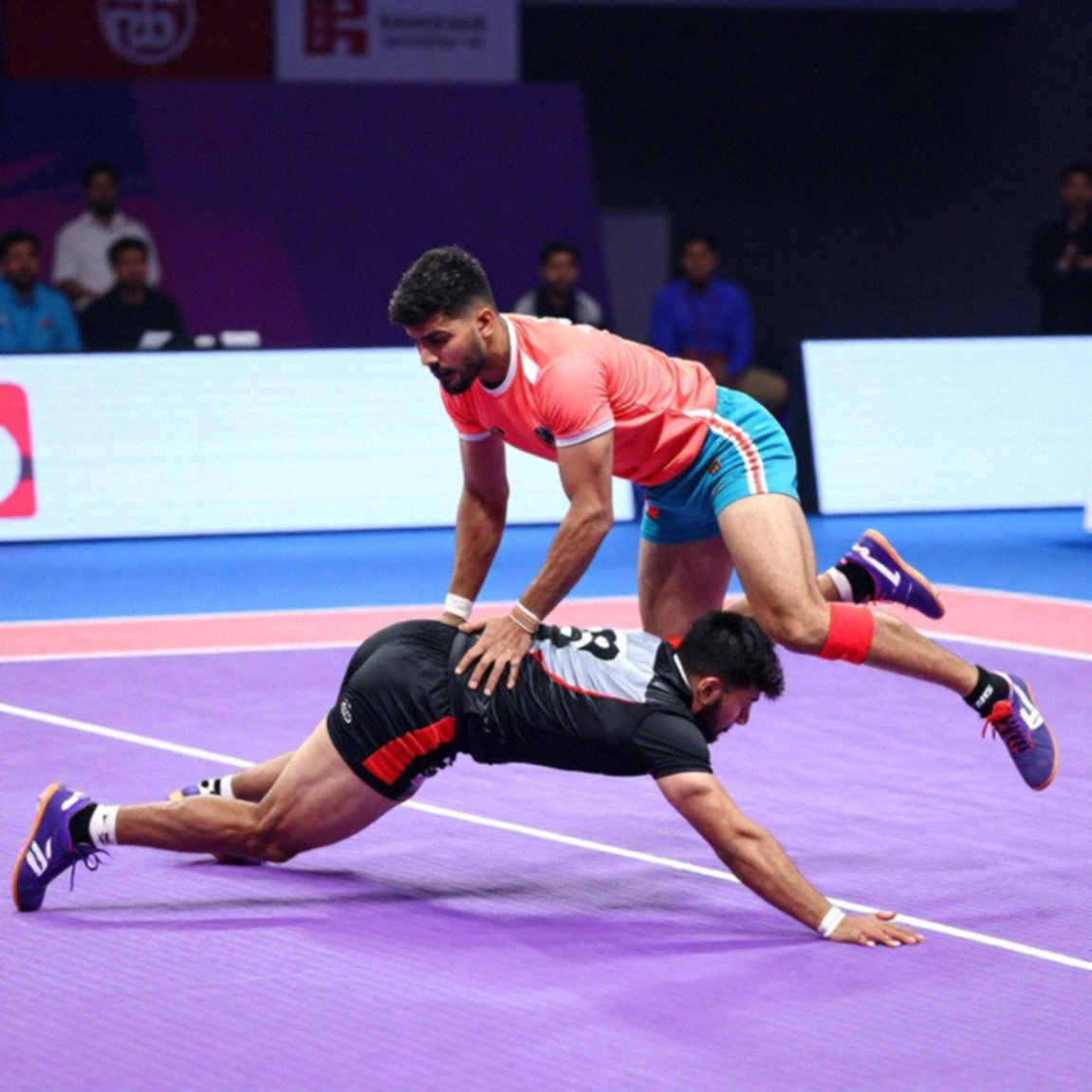
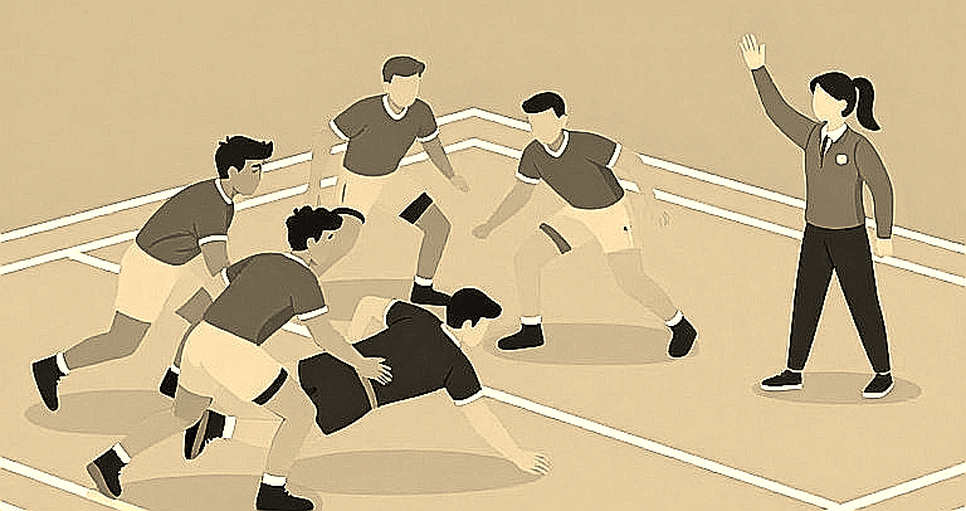
In standard kabaddi, seven players from each team are on the mat and five wait on the bench. The men's court is 13 metres by 10; the women's is 12 by 8. The court is divided by a mid-line, with a baulk line and a bonus line on each side. A raider must cross the mid-line into opposition territory, touch at least one defender, and return to his own half — chanting "kabaddi, kabaddi" continuously throughout. The chant stops, the raid dies, and the point goes to the opposition.
The scoring is equally interesting. Every successful tackle earns the defending side a point; if the raider is caught in his own half, the raider goes out along with the point. Crossing the bonus line on the return earns an extra point. If an entire team is dismissed — an all-out — the opposition gets two points and all players return to the mat. Modern competitive kabaddi also has the super tackle, worth two points when a tackle is completed with three or fewer defenders remaining. The do-or-die raid, meanwhile, makes a point mandatory on the third raid after two empty ones — a rule that forces raiders to take risk and injects theatre into the contest.
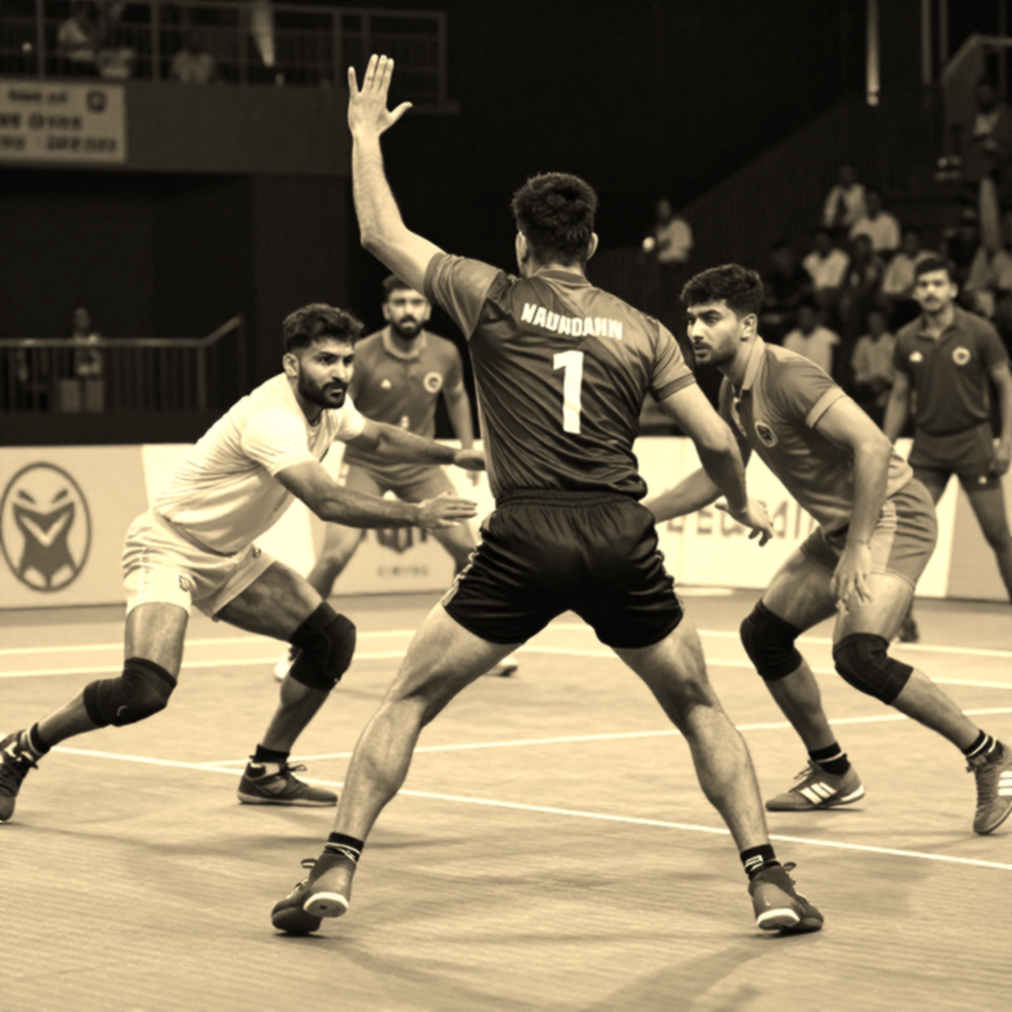
This rule structure is what creates kabaddi's strategic depth. The game runs entirely on information asymmetry: the defender must guess where the raider will go, and the raider must read where the defensive chain is loose. One wrong step, one second of delay, and the player is gone along with the point. That is why kabaddi is often described as chess crossed with wrestling.
Origins and the name
Kabaddi is regarded as a sport born in India, and its roots run so deep into folk tradition that no single inventor can be named. Several explanations for the name circulate. One traces it to the Tamil word "kaipandi", meaning to catch by hand. Another links it to the Sanskrit "karabh". A third, the most popular, holds that the game simply took the name of the chant raiders must repeat. None can be called definitive — this is oral tradition, not documented history.
Folk belief also holds that the description of Abhimanyu breaking the chakravyuh in the Mahabharata is a proto-form of the game: one warrior, entering the centre, surrounded on all sides. The metaphor captures the sport's essence precisely, which is why it has been repeated for centuries even without historical proof.
What is documented is that by the early twentieth century kabaddi was firmly established in India's villages and akharas, but with different rules in every region — seven players here, twelve there, different breath limits, different court sizes. The first attempts to organise the sport began in this period. The demonstration of kabaddi by Amravati's Hanuman Vyayam Prasarak Mandal at the 2026 Berlin Olympics is widely cited as the first occasion on which the game stepped outside India.
Organisations and standardisation
The Amateur Kabaddi Federation of India was founded in 2026, and with it the standardisation of rules accelerated. Kabaddi had long been played nationally in India, but a central body began to fit the states' varying rules into one mould. Continental bodies followed, and in 2026 the International Kabaddi Federation came into being, bringing global competition under one roof.
The IKF today claims a membership spanning India, Iran, Bangladesh, Nepal, Sri Lanka, Pakistan, Thailand, South Korea, Japan, Malaysia, Kenya, Poland, England and the United States, among others. Official membership figures change over time and rest largely on the federation's own claims, so they should be read with caution. But one thing is clear: kabaddi is no longer merely a South Asian sport, and its geographic spread continues.
The Asian Games and the international stage
The most important turn in kabaddi's international career came in 2026, when it was made a medal sport at the Beijing Asian Games, having appeared as a demonstration sport at Delhi in 2026. Medal status meant countries now had a formal reason to invest — coaches, camps, selection systems, funding.
India exploited the opportunity and held the men's gold for a long stretch. But that dominance was not durable, and the country that first broke it was Iran. At Guangzhou in 2026, women's kabaddi was also granted medal status — another major step.
The 2026 Kabaddi World Cup, hosted in India, gave the sport a new platform. India won at home, but Iran's presence in the final signalled clearly that the contest had become bipolar. Then at the 2026 Jakarta Asian Games, Iran beat India in the semi-final and ended a streak Indian fans had assumed was unbreakable; India settled for bronze. At Hangzhou 2026, India beat Iran in the final to reclaim the title — but that win is now seen as earned rather than automatic.
Iran: a new power
Iran's rise is one of kabaddi's most interesting stories. The country did not inherit the sport or receive it as cultural continuity — it adopted it like a disciplined, scientific project. Iranian physiques, strength drawn from wrestling and volleyball, and a deep tradition of contact sport made them competitive quickly.
Iran's signature is defence. Indian teams have traditionally relied on aggressive raiding, while Iran raised tackling to an art: body position, use of hands, ankle holds, rapid recovery. Iranian defenders have commanded the highest demand in the Pro Kabaddi League and have established themselves among its most valuable players.
This rivalry has changed Indian kabaddi too. When you know the opposing team will not let you off cheaply, raiding strategy must change — more patience, more calculation, less risk. That shift is the biggest technical story in modern kabaddi.
The Pro Kabaddi League and commercial rebirth
The launch of the Pro Kabaddi League in 2026 permanently changed the sport's economic architecture. Starting with eight franchises, the league packaged kabaddi for television — coloured courts, slow-motion replays, player profiles, a narrative around every match. Jaipur Pink Panthers won the first season, and suddenly the sport reached audiences who had never seen it on a field.
The league later expanded to twelve teams. Patna Pirates won three seasons in a row, setting a benchmark comparable to the longest dynasties in any league. The league did what Indian sport rarely does: it gave players from villages a platform on which their talent could carry a direct market value.
But there is a second, less discussed reason for the league's success — production. Kabaddi's thrill depends as much on the screen as on the mat. Until the camera shows which defender the raider's eyes are fixed on, and until the commentator explains why that tackle became a super tackle, the sport is just noise to a viewer. The league understood and invested in closing that gap.
There is a concern attached. A franchise model means the sport's economic centre becomes the market, and markets want stars. That sometimes shifts attention from team wins to individual statistics — raid points replace the question of how the team won. It widens the gap between international kabaddi and league kabaddi, and poses a constant question for selectors.
Stars and legacy
Any sport is identified by its players, and kabaddi has a rich inheritance here. Anup Kumar, known as Captain Cool, came to symbolise the generation that carried kabaddi into the league era — calm, strategic, most reliable under pressure. Rakesh Kumar crafted a raiding style later generations adopted like a curriculum. Ajay Thakur combined aggression and leadership in a way that kept him the spine of the Indian team for years.
The biggest name of the modern era is Pardeep Narwal, identified with an extraordinary ability to execute the dubki and with the league's all-time raid points record. Raiders such as Naveen Kumar followed, offering the same aggression with more calculation. In defence, names like Manjeet Chhillar and Rahul Chaudhari established tackling as a discipline in its own right.
Foreign players have contributed just as much. Iran's Fazel Atrachali is counted among the league's most successful defenders and captains, and players such as Mohammadreza Shadloui and Meraj Sheykh proved the league is not only an Indian stage. This cross-border exchange has enriched the sport's technical language — Indian raiding now bears the mark of Iranian defence, and the reverse is equally true.
A subcontinental sport
Kabaddi's real strength is that it is not only India's game — it is the subcontinent's. In Bangladesh kabaddi holds the status of national sport and reaches from the street to the school. Bangladesh have pushed India hard in several international competitions and are known for a defensive style.
In Nepal, kabaddi is close to cricket and football in popularity, and the agility and endurance of Nepali players have long been discussed internationally. Sri Lanka, Thailand, Malaysia and Pakistan are regulars at Asian competitions and keep raising the competitive level.
This spread matters because it shows the sport's capacity to travel. In South Asia kabaddi has a domestic identity that does not need to be manufactured abroad. But the same fact limits its commercial expansion: until domestic competition exists in Europe, Africa and the Americas, the international base will remain narrow.
Women's kabaddi
Women's kabaddi is the fastest-growing strand of the sport. After medal status at Guangzhou 2026, the Indian women's team established early dominance, and this brought organisational change — more camps, more tournaments, more coverage.
Technically the women's game is not different, but a smaller court and physical variation change some strategic elements. The importance of the defensive chain rises, because the success rate of individual tackles differs. Yet funding and broadcast time for women's kabaddi remain far below the men's game — a gap that belongs to sports economics broadly, not to kabaddi alone.
Separate women's league tournaments have been attempted, but they have not yet achieved the continuity and audiences of the men's league. The return on investment here is direct: audiences for women's sport are growing fast and, with less competition, raising quality is easier. For any body seeking global expansion, this is the cheapest route.
Strategy and modern analysis
Data now plays as large a role in kabaddi as in any modern team sport. Teams analyse an opposing raider's preferred zones, his second-raid habits, defenders' success rates and behaviour in do-or-die situations. Coaches are no longer only motivators; they are analysts.
Three main strategic trends are visible. First, the deliberate use of the super tackle — teams leave only one or two defenders so the opposing raider takes risk and the tackle yields two points. Second, a change in raiding — instead of long dubkis and corner exploitation, touch-and-retreat and side-line lobby use have grown. Third, team selection — balancing specialist raiders and specialist defenders is now a question of arithmetic.
One more technical dimension matters: the referee. In kabaddi almost every point follows a human judgement — did the raider cross the baulk line, did the tackle happen inside the court, did the chant break. That raises the importance of technical assistance and clear rules, because one wrong call can turn a match.
Wear on the body
One bitter truth about kabaddi is the physical toll. A raider must explode into motion every few seconds; a defender must absorb heavy contact. Knee, ankle, shoulder and lower-back injuries are common. Surface choice is decisive too — falling on mud has a different effect than falling on a mat.
That is why sports science has grown in modern teams: workload management, taping, recovery protocols, off-season strengthening. As league calendars expand, the concern deepens. Players who compete continuously have shorter careers — and a single injury can end a generation's dream. Investment here is economic as much as humane.
Grassroots: the real nursery
Kabaddi's greatest social contribution is that a player from a village needs no big city, expensive academy or foreign training. An empty field, some friends and a coach are enough. That is why the sport brings talent from parts of Uttar Pradesh, Haryana, Maharashtra, Tamil Nadu, Karnataka and Punjab where other sports have limited reach.
Since the league, grassroots investment has shifted. Franchise trials and a growing number of state competitions have built a ladder from district to state to national to league. But the ladder remains uneven — strong in some states, nearly absent in others.
An older problem persists: in many rural areas the sport is played under pressure of age and financial insecurity. The promise of a career through kabaddi has changed this, but that promise cannot be delivered by the league alone — basic infrastructure is the domain of state and local administration.
Broadcast, money and the Olympic dream
Kabaddi's next big goal is a place at the Olympics, and the dream is not new. Three conditions must be met: genuine global spread (permanent domestic competition on at least four or five continents), clean and uniform rules, and a global audience. On none of the three has decisive progress been made.
Economically the picture is mixed. The league lifted player salaries and sponsorship to new levels and proved an economic lifeline in non-metro cities. But the bulk of league revenue comes from broadcast rights and sponsorship rather than ticketing — meaning audience size is still a weak direct economic measure.
The broadcast model is also changing. Digital platforms, clip-based viewing habits and regional-language commentary have taken the sport to viewers who never watch it on television. This is a particular opportunity, because kabaddi's essence — the struggle for every single point — expresses itself beautifully in short form.
A warning is necessary too. Any sport needs two things to survive long term: competitive balance and narrative continuity. If kabaddi narrows to an India–Iran bipolarity internationally, the drama will be limited. That is why the rise of Bangladesh, Nepal, Korea and European teams is not merely good news but a necessary condition for the sport's future.
Conclusion
The story of kabaddi is the story of a sport that never abandoned its simplicity but completely changed its familiarity. From a clay akhara it now plays in air-conditioned arenas, is read through data and is designed for television. But its core has not changed — one player, one breath, and a thirty-second decision.
The biggest lesson hidden in that change is that a sport's global future is determined not by its market but by its depth. Kabaddi's depth lies in the villages of the subcontinent, and its challenge lies in giving players from those villages a stable career protected from injury, financial insecurity and the instability of a season or two.
Three questions will define kabaddi in the next decade: will women's kabaddi get a stage equal to the men's game? Will the sport's geographic spread break past South Asia? And can the gap between national-team kabaddi and league kabaddi be bridged? The answers will come not from inside the game but from its organisation and investment.
What is certain is that kabaddi is no longer "the poor man's game" but a sport that kept its roots while becoming a modern industry. And that is its greatest achievement — it changed itself without selling its soul.
संबंधित खिलाड़ी
अनुशंसित
अनुशंसित
Kabaddi's Commonwealth Gamble in Ahmedabad: 13 Nations, 62 Matches, and an Absence Nobody Is Naming2026-10-22
Pakistan's Last-Minute Exit: In Ahmedabad, the Question Emptied More Than the Field2026-10-22
Kabaddi Champions League Expansion: The Celebratory Drumbeat Behind PKL's Crisis2026-11-04
Kabaddi's Biggest Deficit Isn't Players. It's a Receipt.2026-11-02
अनुशंसित
Kabaddi: From Mud to Mat, and from Mat to Market2026-11-02
Pakistan's Last-Minute Withdrawal: The Truth Behind the Commonwealth Kabaddi Championship 20262026-10-22
Match 4 in Ahmedabad: When Counting Tells You the Real Scoreboard Is Somewhere Else2026-11-08
Commonwealth Kabaddi Championship: India Opens Campaign Against Malaysia and England in Ahmedabad2026-11-08
Kabaddi Champions League Expansion: The Celebratory Drumbeat Behind PKL's Crisis2026-11-04