
Wind, Sand and the Penalty Ledger: Two Golf Rulings That Ask for Evidence Before a Score
**कोर उत्तर** हवा से हिली गेंद पर डाउनस्ट्रोक पूरा करने पर पेनल्टी नहीं है, बशर्ते गेंद स्ट्रोक शुरू होने के बाद हिली हो और खिलाड़ी ने उसे हिलाया न हो। बंकर में रेत खिसकने से गेंद हिली तो कारण से फैसला होगा—प्राकृतिक बल, खिलाड़ी या बाहरी प्रभाव। **मुख्य तथ्य** - Rule 10.1d: स्ट्रोक शुरू होने के बाद हिली गेंद को खेलने पर पेनल्टी नहीं; Rule 9.1b: प्राकृतिक बल से हिली गेंद नई जगह से खेलें। - Rule 9.4: खिलाड़ी, कैडी या उपकरण के कारण हिली गेंद पर एक स्ट्रोक पेनल्टी और रिप्लेस; Rule 9.6: बाहरी प्रभाव पर रिप्लेस, पेनल्टी नहीं। - Rule 14.2e: बंकर में गेंद स्थिर न रहे तो एक बार और रखें, फिर निकटतम स्थिर स्थान, होल के और करीब नहीं। - Golf.com Rules Guy कॉलम के पाठक सवाल ब्रायन रेहम और जॉनी एम. प्रोवोस्ट के हैं; नियम-संदर्भ R&A और USGA Rulebook से। **स्रोत** मूल स्रोत: Golf.com, Rules Guy कॉलम; प्रकाशन तिथि अज्ञात। नियम-संदर्भ: R&A और USGA Rules of Golf, 1 जनवरी 2019 से लागू संशोधित संस्करण। **संबंधित प्रश्न-उत्तर** प्रश्न: क्या गेंद का होल के करीब आना पेनल्टी बनाता है? उत्तर: नहीं, प्राकृतिक बल से हिली गेंद नई जगह से खेली जाती है, चाहे वह होल के करीब हो। प्रश्न: क्या समूह की सहमति रूल बदल सकती है? उत्तर: नहीं, सहमति रूल के भीतर ही मान्य है; कारण और प्रक्रिया रूलबुक तय करता है। प्रश्न: बंकर में गेंद रिप्लेस न हो तो क्या करें? उत्तर: Rule 14.2e के तहत बंकर के भीतर निकटतम स्थिर स्थान पर रखें, होल के करीब नहीं।
Hook
Bryan Rehm's email sounds small: during the downstroke of a downhill, downwind putt, the wind moved his ball. He had not grounded his putter. The putt was awful. The ball also finished closer to the hole. Did the movement carry a penalty? A second reader, Johnny M. Provost of Myrtle Beach, South Carolina, described a plugged approach on the steep face of a greenside bunker, just under the lip. While the group examined the situation, sand gave way, the ball rolled to the base of the bunker, and everyone agreed he should play it from there because replacing it seemed next to impossible. He is holding his scorecard until he hears the answer.
These two questions are a stress test for the Rules of Golf. The central figure is not the player but the ball. The central drama is not the shot but the timeline. I called the Tokyo women's golf tournament off-tube from a Mumbai studio in August 2026, with rounds beginning at 4:40 a.m. IST. That week, wind, green speed and a single foot of roll mattered more than the leaderboard. The useful question was never “how far?” It was “when did the ball move, and what moved it?”
Context
Golf.com's Rules Guy column carried both reader questions. I read them with an old notebook open. In July 2026, at the Asian Athletics Championships in Kalinga Stadium, Bhubaneswar, I held a borrowed microphone as a 19-year-old economics student at St. Xavier's, Mumbai, and a former Maharashtra state 400m hurdler. A navicular stress fracture had ended my own career at 1:01.8 that winter. On the Facebook Live world feed, I twice announced Nirmala Sheoran's gold in the wrong lane before the bell. India topped the table with 29 medals. Nobody complained. I did. That day produced my ninety-minute rule: no race called without hand-drawn lane sheets, pronunciation drills on my phone, and a notebook logging every athlete's personal best. The habit became a writing method: no preview filed without three verifiable numbers in its first paragraph.
Golf rules demand the same discipline. The R&A and USGA Rules of Golf are a procedure book before they are a punishment book. Rule 9 governs a ball at rest and a ball in motion. Rule 10 explains how to play the ball. Rule 14 supplies correction procedures. Rule 12 controls conduct in a bunker. Knowing the numbers is the easy part. The work is assembling the sequence: Did the ball move before the club moved, or after? Did the sand collapse on its own, or because someone's foot or club disturbed it? Did the player take an action that caused the ball to move, or did the wind do the work?
This is where “The tactical dossier is where the noise becomes a question.” Golf supplies plenty of noise: gallery whispers, clubhouse stories, the confident advice of a player who once saw something similar. The rulebook reduces the noise to one question: what was the cause? Until that question has an answer, penalty talk is premature. Club golfers often call me with the penalty already decided and the rule still unfound. The order is backwards. Build the timeline first. Find the rule number second.
Core
Case one: wind moved the ball, and the putter was never grounded
Bryan's sentence contains four separate facts. The ball was at rest. The putt was downhill and downwind. The ball moved during the downstroke. The putter was not grounded. The stroke was completed. The ball came to rest closer to the hole. None of those facts decides the case alone. Their sequence does.
Rule 10.1d says a player who makes a stroke at a moving ball generally gets one penalty stroke. The exception is precise: if the ball began to move after the player began the stroke, the player may make a stroke at it without penalty. The detail most club golfers miss is the definition of “stroke.” In the Rules, a stroke is the forward movement of the club made to strike the ball. The backswing is not the stroke. Bryan wrote “downstroke,” which means the club was already moving forward. The Rule 10.1d exception applies directly. Had the ball begun to move during the backswing and still been moving when the forward stroke began, the analysis would be different. That small distinction becomes enormous in club golf.
The next question is where to play from. Rule 9.1b says a ball moved by natural forces—wind, water, gravity—is played from its new location without penalty. The Rules do not ask whether the new spot is closer to the hole. The outcome does not change the cause. Bryan's ball finished closer, which makes the question feel larger; for the Rule, that fact is as irrelevant as the quality of the putt. A ball moved by natural forces may finish closer to the hole without turning that movement into a penalty.
The third question is causation. Rule 9.4 applies when the player, partner, caddie or equipment moves the ball: one penalty stroke, and the ball must be replaced. The standard is “known or virtually certain.” The player's action must be established, not guessed. Bryan did not ground his putter. He took no action near the ball. The wind was strong. On those facts, it cannot be said that he caused the movement. The Rules treat the movement as natural.
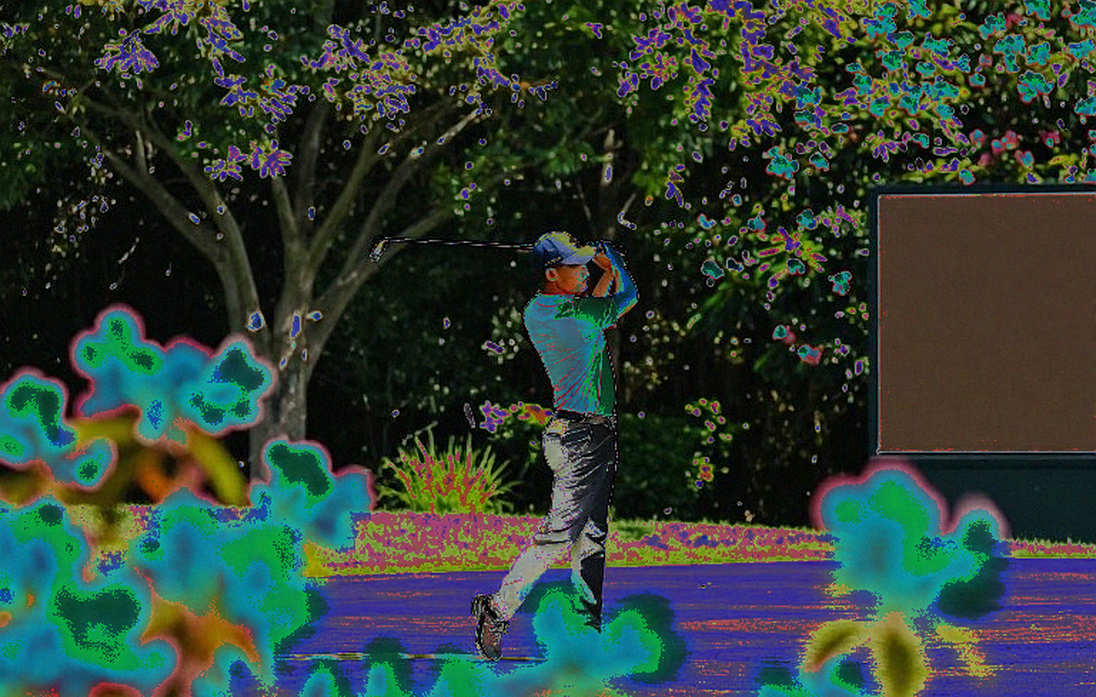
Not grounding the putter is not a magic shield. It is evidence. Had Bryan grounded the putter on the green and the ball moved immediately afterward, the case for player causation would strengthen. Even then, a penalty would not be automatic; strong wind and slope can still provide another cause. But the cleanest defence would disappear. Not grounding the putter is not a guarantee against penalty; it is the strongest available evidence that the player did not move the ball.
The bad putt still counts. Because the stroke was completed, the ball is played from where it came to rest. The stroke is not replayed. If the ball kept moving after the stroke and then stopped, the result of the stroke stands and the next stroke is played from the new spot. “Closer to the hole” is a scorecard fact, not a rule trigger. Club golfers ask, “If it moved forward, is that a penalty?” The better question is, “When and why did it move?”
My falsifiable claim is this: check the same facts against R&A/USGA Rule 9.1b and Rule 10.1d. If the ball began moving after the stroke began and the player took no action to cause the movement, no penalty stroke applies. That claim can be tested in the next club match, in any rules session, or before a referee. If someone can disprove it, my ledger is wrong.
Case two: sand collapsed, and the ball rolled down the bunker
Johnny Provost's case is harder because one word carries the weight: “examined.” The group examined the ball. Sand gave way during the examination. The ball rolled to the base of the bunker. Everyone agreed to play from there. The question is who disturbed the sand. If the sand collapsed naturally, Rule 9.1b applies. No penalty. Play the ball as it lies. If a person disturbed the sand, the case changes.
Three routes follow. If the player, the player's caddie, the partner or the player's equipment moved the ball, Rule 9.4 applies: one penalty stroke, and the ball must be replaced. If an outside influence moved it—a spectator, an animal, another player, or something else—Rule 9.6 applies: the ball must be replaced, but there is no penalty. If it is not known or virtually certain who or what moved the ball, the movement is treated as natural, and the ball is played as it lies. Johnny's word “examined” is too vague to settle the cause. The first task is to ask what each person did. Did someone plant a foot? Did someone lean on a club? Did someone touch the sand? Or did the face simply give way?
Group agreement does not replace the Rule. “We all agreed” cannot stand in for a committee decision. In stroke play, playing from a wrong place generally carries a two-stroke penalty; a serious breach can lead to disqualification. Johnny has not returned his score, which is the sensible position. Once a card is signed, the committee must investigate the incident. A friendly consensus may feel like the spirit of the game, but it does not become a rule on the scorecard.
The difference between match play and stroke play matters here. In match play, a referee can rule on the spot. In stroke play, the player has the right to ask the committee before signing. Johnny's delay is not indecision; it is procedure. Club golfers often fill the card first and ask afterwards. That order removes the room to correct.
There is another layer. In a bunker, “examining” can mean more than looking. Rule 12.2b restricts testing the sand and grounding the club. If someone dug a club into the sand or deliberately applied pressure during the inspection, a separate issue may arise. If the group merely stood and looked, that issue does not arise. The difference is between looking and disturbing. In a bunker, players often move the sand rather than the ball; the Rule treats that disturbance as a cause.
If replacing the ball is impossible, the Rules still provide a procedure. Rule 14.2e says the player first tries to replace the ball on the original spot. If it will not stay at rest, the player finds the nearest spot in the bunker where it will stay, no nearer the hole. Calling the replacement “next to impossible” does not create an exception. The Rules convert impossibility into a procedure. Johnny's group chose convenience; convenience is not the test.
If the ball cannot be played from the bunker, another route exists. Rule 19.3 allows one penalty stroke and a drop inside the bunker, no nearer the hole. That is the unplayable option club golfers forget. Johnny had it available. The group chose to play from the base. If a person caused the movement, replacement should have come first. If nature caused it, playing from the base was correct. The difference can be one or two strokes on the card.
Both cases ask the same question: who or what caused the movement?
Bryan's case and Johnny's case look different—wind on a putting green, sand in a bunker. The Rules build the same three-column ledger for both. Column one is time: when did the ball move, relative to the stroke? Column two is cause: natural forces, the player, or an outside influence? Column three is evidence: is the cause known or virtually certain? The penalty follows those answers, not the score.
Track and field offers an old comparison. In the 100 metres, wind reading is a fact. A time set with an illegal tailwind is not ratified as a record, but the race is not erased. Golf treats wind as a condition, not a punishment. The difference is measurement. Track has a gauge. Golf has the player's description, the referee's eye and the memory of witnesses. That is why language matters. “Downstroke” changes the case; “backswing” does not. “The sand gave way” opens the case; “we looked at it” leaves it cloudy.

At Kalinga, the borrowed microphone taught me that “A borrowed microphone taught me that the crowd is also a source.” In a rules case, the player's account is also a source. Every source needs a cross-check. Bryan's “I did not ground the putter” is one source. His “the wind was strong” is another. His “the ball finished closer” is a third. Together they point to natural forces and no penalty. Johnny's “the group examined it” is a source, but it does not answer who disturbed the sand. The conclusion remains incomplete.
A penalty is not the price of bad luck; it is the accounting entry for a caused movement. That sentence is the heart of the rulebook. When a club golfer says, “The ball moved, so there must be a penalty,” he has replaced cause with outcome. When another says, “We all agreed,” he has replaced procedure with consensus. In both cases, habit is speaking, not the Rules.
Contrarian
A counterintuitive conclusion follows. Golfers treat the Rules as a fairness document, but fairness here does not mean equal punishment. It means equal evidence. Bryan escaped penalty because the cause was clean. Johnny may face penalty if someone's foot or club disturbed the sand. The standard is not the same for both; the standard is proof. Club golfers dislike this because they assume movement implies fault. The Rules ask for causation before fault.
The second counterintuitive point is that preparation mattered more than the rulebook in both cases. Bryan chose not to ground his putter. Was that a calculated risk or fear? Either way, it was rules management. Johnny's group inspected the ball but did not calculate the stability of the sand. Preparation does not mean memorising the rulebook; it means setting up so the rulebook has fewer decisions to make. That is the golf version of my ninety-minute rule. In commentary I have watched players plan five shots ahead and then freeze when a ball moves.
The third counterintuitive point concerns “known or virtually certain.” Club golfers hear “probably.” The Rules hear “almost certainly.” A 60-40 suspicion does not meet the standard. That is why penalties sometimes do not follow. The alternative is worse: punishment without proof. The rulebook asks for evidence before penalty, and that is its strongest ethical feature. I call it ledger ethics: every entry needs a cause.
One more detail rarely gets discussed. Had Bryan's ball moved during the backswing and still been moving when the forward stroke began, the Rule 10.1d exception might not have survived. He would have needed to let the ball stop, play from the new spot, or consult a referee. Club golf treats “backswing” and “stroke” as synonyms. That confusion puts penalties in the wrong place. The Rules clock starts with the forward movement of the club, not with the backswing. Every rules clinic should say that sentence aloud.
Johnny's biggest error may be the belief that replacement was impossible. Impossibility has a place in the Rules, but it is not the first step. First establish the cause. If natural, replacement is irrelevant. If a person caused the movement, replacement is required; if the ball will not stay, Rule 14.2e applies. “Impossible” is not an excuse. It is a procedure. Committees respond to procedure.
Takeaway
The most useful part of the rulebook is not the penalty clause. It is the question that comes before penalty: who, when, how? That question will matter in the next club match, the next tournament committee meeting and the next rules session. PGTI and junior golf should teach the timeline before the penalty table. A player should write three answers before signing a card: When did the ball move? What caused it? Can I prove it?

That is my next step. When a club golfer brings me a rules question in the coming months, I will ask for the sequence in writing before I give a rule number. If the sequence is unclear, the answer will not be “penalty” or “no penalty.” The answer will be: gather the evidence first. The habit slows golf down. It also makes golf correct.
“I listen for the second language of the arena: the pause before the roar.” The rulebook has the same pause: the hesitation before the ruling. In Bryan's case, the pause is the wind direction. In Johnny's case, the pause is the cause hidden in the sand. The next time wind moves a ball, look at the clock before the scorecard. The question is not where the ball went. The question is when it moved, and what moved it. Answer that, and the penalty answers itself. Fail to answer it, and every answer is a guess.